Boston Marathon 2026: Course Guide, Heartbreak Hill and Time Predictions
Every April, thousands of runners who earned their place on this start line make the same mistake within the first 6 km – they let gravity do the pacing. The Boston Marathon course drops roughly 40 metres between Hopkinton and Framingham, and that gentle downhill seduces even experienced marathoners into banking time they will repay with interest on the Newton Hills. According to the Boston Athletic Association, the median positive split across all finishers is consistently above four minutes. The course is not the problem. The pacing is.

The Boston Marathon 2026 takes place on Monday 20 April – Patriots’ Day in Massachusetts. If you have qualified, deferred, or secured a charity place, this guide will walk you through every section of the 42.195 km point-to-point course, help you set realistic pace targets, and show you how to predict your finish time based on your actual fitness rather than your ambition.
Why Boston is unlike any other marathon major
Boston is the oldest annually contested marathon in the world, first run in 1897. It is also the only World Marathon Major that requires a qualifying time for general entry. That single rule changes the character of the entire field. You will not find many first-time marathoners on this course. The runners around you have already proven they can race – which makes it even easier to get pulled into a pace that is too fast for the terrain ahead.
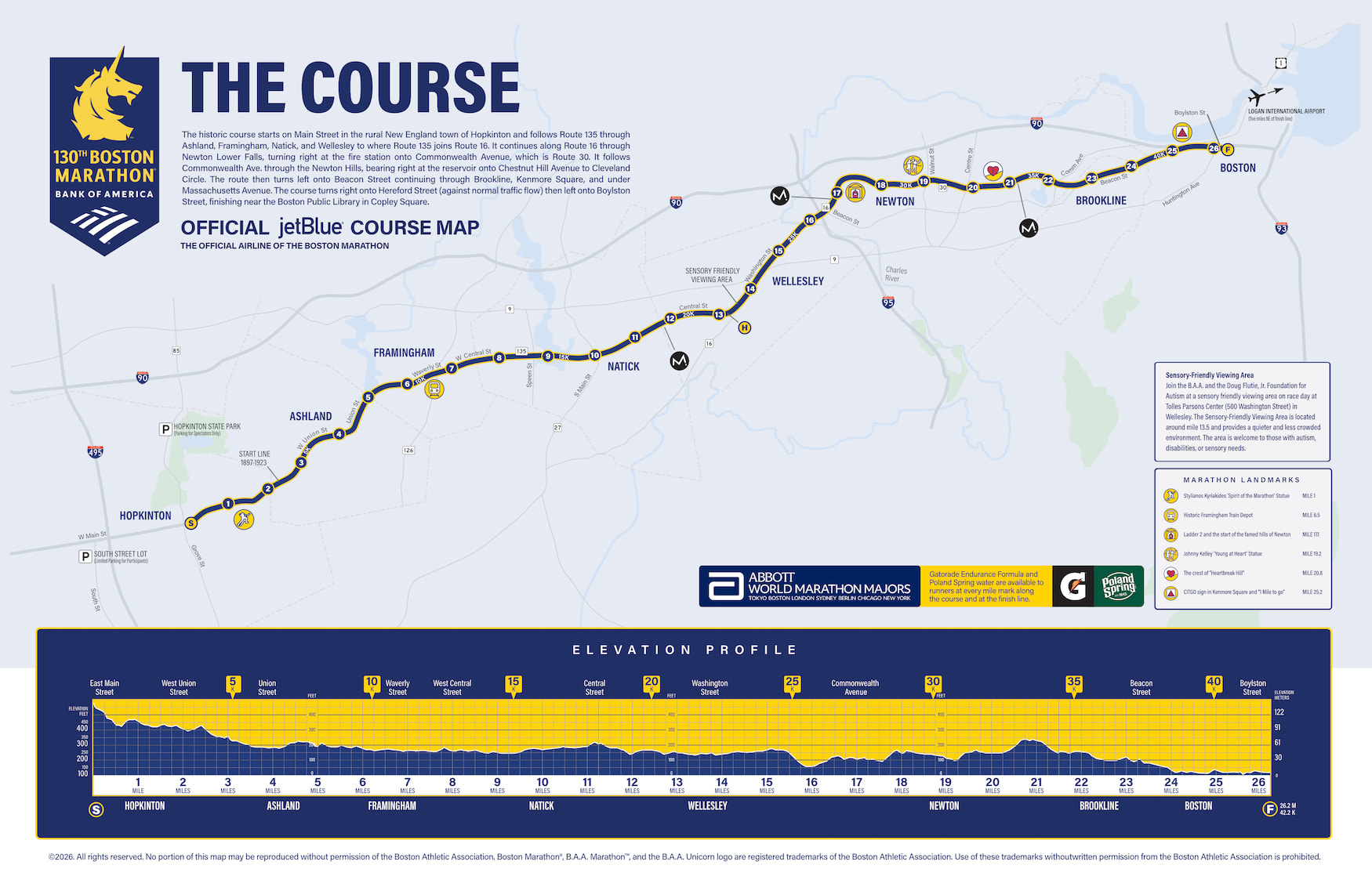
The course is point-to-point, running west to east from Hopkinton to Copley Square in downtown Boston. World Athletics classifies it as record-eligible, though the net elevation drop of approximately 136 metres and the point-to-point layout mean times set here do not count for world records. The Boston Athletic Association manages the event under World Athletics rules, with timing mats at every 5 km split.
The qualifying standards for the 2026 race follow the updated Boston Athletic Association thresholds. For the 18-34 age group, the men’s qualifying time is 2:55:00 and the women’s is 3:25:00. Each age bracket adds five minutes. Even with a qualifying time, entry is not guaranteed – the BAA typically applies a cut-off that shaves one to three minutes off the published standards depending on the number of applicants.
Full course breakdown: Hopkinton to Copley Square
Start to 10 km – Hopkinton to Ashland
The race begins on the village green in Hopkinton at an elevation of approximately 150 metres above sea level. The first 6 km drop steadily – around 40 metres of descent – which is where the so-called “Boston Curse” begins. Your legs feel fresh, the road is tilting in your favour, and every split comes in faster than planned. Resist it. The energy you spend braking on downhills and the quad damage from the eccentric loading will surface later.
By 10 km you have passed through Ashland and the road begins to level out. If your first 10 km split is more than 20 seconds per kilometre faster than your target average pace, you have already made the most common Boston mistake.
10 km to 21.1 km – Framingham to Wellesley
This section is the flattest part of the course. You run through Framingham, Natick, and into Wellesley. The road is gently rolling but nothing dramatic. The famous Wellesley College “Scream Tunnel” hits you just before halfway – a wall of noise from students lining both sides of the road. It is a genuine energy boost, but do not let it push your pace up.
Your half marathon split here is the single most important number of your race. If you are targeting a 3:30:00 finish and you pass halfway in 1:42:00, you are in trouble. A disciplined runner hits this point at 1:44:30 to 1:45:30 and feels controlled.
21.1 km to 33 km – Wellesley to the Newton Hills

After the halfway mark, the course continues through Wellesley and into Newton Lower Falls. The terrain begins to change around 25 km as you encounter the first of four significant climbs known collectively as the Newton Hills. These climbs are not steep by trail running standards – each rises between 10 and 27 metres over roughly a kilometre – but they arrive at exactly the point where glycogen stores are depleting and any early pace debt starts to compound.
The first three hills between 26 km and 31 km are rehearsals. Run them by effort, not by pace. If your hill-adjusted pace shows you need to add 15 to 20 seconds per kilometre on a 3 to 4 % gradient, trust that number and slow down accordingly. Trying to maintain flat-ground pace on these climbs is the fastest way to hit the wall before 35 km.
33 km to 34 km – Heartbreak Hill
Heartbreak Hill is the fourth and final Newton climb, peaking at approximately 34 km. It rises about 27 metres over 800 metres – a gradient of roughly 3.3 %. On fresh legs, you would barely notice it. At 33 km into a marathon, after three preceding hills and a fast early descent, it can break a race apart.
The name comes from the 1936 race when defending champion Johnny Kelley was overtaken by Ellison “Tarzan” Brown on this very hill. The heartbreak is real, but it is not the hill itself that causes it – it is the accumulated fatigue from the first 33 km of poor pacing decisions.
Run Heartbreak Hill at a sustainable effort. Let your pace drop by 15 to 25 seconds per kilometre compared to flat sections. Shorten your stride, keep your cadence steady, and focus on the crest. Once you are over it, you have 8 km of predominantly downhill running to the finish.
34 km to 42.195 km – Newton to Copley Square
After cresting Heartbreak Hill, the course drops back down through Brighton and into Brookline. The final 5 km take you along Beacon Street, past Kenmore Square and Fenway Park, before the iconic right turn onto Hereford Street and a left onto Boylston Street. The last 600 metres on Boylston are flat, wide, and lined with enormous crowds. If you have paced well, this is where you pass the runners who did not.
Pace targets by finish time goal
The table below shows target splits for common finish times. These assume a conservative first half with a controlled effort through the Newton Hills – the most realistic strategy for Boston’s deceptive terrain.
| Finish time goal | Average pace (min/km) | Half split target | 30 km split target |
|---|---|---|---|
| 2:59:59 | 4:16 min/km | 1:30:00 | 2:08:00 |
| 3:14:59 | 4:37 min/km | 1:37:30 | 2:19:00 |
| 3:29:59 | 4:58 min/km | 1:45:00 | 2:29:30 |
| 3:44:59 | 5:20 min/km | 1:52:30 | 2:40:00 |
| 3:59:59 | 5:41 min/km | 2:00:30 | 2:50:30 |
| 4:29:59 | 6:24 min/km | 2:15:30 | 3:12:00 |
| 4:59:59 | 7:07 min/km | 2:30:30 | 3:33:30 |
Notice the half split targets are deliberately conservative – 30 to 60 seconds slower than a perfectly even split would suggest. This is intentional. On a course with significant hills in the second half, running the first half slightly slower gives you a reserve to absorb the Newton climbs without collapsing your average pace.
These are starting points. Your targets should reflect your recent training data. Predict your finish time using a recent 10 km or half marathon result to get a personalised target built around your fitness.
How to predict your Boston Marathon finish time

A pace chart gives you a ballpark. A proper finish time prediction uses your actual race data – a recent 10 km, half marathon, or even a strong parkrun – and applies validated models to estimate what you can realistically achieve over 42.195 km.
The Riegel formula, widely used in distance running, adjusts for the non-linear relationship between pace and distance. A 50:00 10 km does not translate directly to a 3:31:00 marathon. The fatigue factor over the additional distance adds roughly 5 to 8 % to your average pace, and Boston’s hills add another layer of complexity on top.
To get your prediction:
- Take your most recent race result (ideally within the last 8 weeks).
- Enter it into the Predict Your Time tool.
- Review the predicted marathon time and use it to set your half and 30 km split targets from the table above.
- Adjust for Boston’s terrain – add 2 to 4 minutes to a flat-course prediction to account for the Newton Hills and the early downhill quad fatigue.
If the predictor says 3:40:00 on a flat course, target 3:42:00 to 3:44:00 for Boston. A prediction based on real data is always more reliable than a goal pulled from ambition alone.
Three pacing mistakes that cost minutes in Boston
Riding the early downhills. The first 10 km drop roughly 40 metres, and it feels effortless. Runners routinely come through 10 km 30 to 45 seconds ahead of their planned split. That sounds like free time. It is not. The eccentric muscle loading from sustained downhill running causes quad damage that compounds over the next 30 km. Set your pace calculator targets before the race and stick to them from kilometre one – even when the road is pulling you faster.
Attacking the Newton Hills instead of surviving them. The four climbs between 26 km and 34 km are not the place to prove your fitness. Runners who try to hold flat-ground pace through the hills pay for it on Heartbreak Hill and beyond. Understanding why effort matters more than pace on hills is essential for Boston. Switch from pace-based running to effort-based running at 25 km. Accept a pace drop of 15 to 25 seconds per kilometre on the climbs and recover on the descents.
Panicking after Heartbreak Hill. You crest the hill at 34 km and the road tilts downward again. The temptation is to accelerate hard and “make up” the time lost on the hills. But your quads have already absorbed 33 km of eccentric loading – from the early downhills and the Newton climbs – and hammering a final descent can push you straight into cramping. Run the last 8 km at a controlled effort. You will still be overtaking runners who made mistakes one and two.
Race day logistics for Boston 2026
Several practical factors specific to Boston can affect your pacing and experience:
- Athletes’ Village and bus transport. Runners board buses in Boston Common early in the morning for the 42 km ride to Hopkinton. You may spend 60 to 90 minutes sitting on the ground in the Athletes’ Village before your wave is called. Bring warm disposable clothing, a bin bag to sit on, and extra food. Do not skip breakfast because of nerves – you are burning energy just staying warm.
- Wave and corral starts. Boston uses a wave start system with four waves. Your gun-to-chip gap depends on your wave assignment. Focus on your chip time and ignore the clock at the start line.
- April weather variability. Boston in mid-April is unpredictable. Race day temperatures have ranged from near freezing (2 degrees Celsius in 2007) to above 25 degrees (the infamous 2012 race where temperatures hit 29 degrees and the BAA offered deferrals). Check the race-day weather forecast 48 hours before the race. If temperatures exceed 15 degrees, add 5 to 10 seconds per kilometre to your pace target. If they exceed 20 degrees, consider adjusting your finish time goal entirely.
- Headwinds on Route 135. The west-to-east course means a prevailing easterly headwind can slow the field. In exposed sections through Ashland and Framingham, even a moderate headwind adds effort that your pace does not reflect. Run by effort on windy days.
- Course cut-off. The official cut-off is 6 hours from the start of your wave. Intermediate timing checkpoints are enforced, and runners who fall behind the required pace may be directed off the course.
Your questions about the Boston Marathon 2026
What is a good finish time for the Boston Marathon?
Because every general entry runner has met a qualifying standard, the field is faster than most marathons. The median finish time is typically between 3:40:00 and 3:55:00 – well below the average for other majors. A “good” time is one that matches your current fitness on this specific course. Use a time prediction tool with a recent race result to find a realistic target, then add 2 to 4 minutes for the Boston course difficulty.
How hard is Heartbreak Hill really?
On paper, Heartbreak Hill is roughly 800 metres at a 3.3 % gradient – about 27 metres of elevation gain. On fresh legs, most runners would not even classify it as a hill. At 33 km into a marathon, after three preceding climbs and the quad damage from the early downhills, it feels significantly harder. The hill itself is not the challenge. The 33 km before it is. Prepare for Boston by including hilly long runs in training and practising effort-based pacing on climbs. See our Boston Marathon race page for full course details.
Should I run a negative split at the Boston Marathon?
A true negative split – running the second half faster than the first – is rare at Boston because of the Newton Hills. A more realistic goal is an even effort split, which will show as a slight positive time split (second half 1 to 3 minutes slower). Run the first half conservatively, manage the hills by effort, and aim to finish the last 5 km at a strong, controlled pace.
What are the 2026 Boston Marathon qualifying times?
The Boston Athletic Association sets qualifying times by age and gender. For the 18-34 age group, the men’s standard is 2:55:00 and the women’s is 3:25:00. Each subsequent five-year age bracket adds five minutes. Meeting the standard does not guarantee entry – the BAA typically applies a cut-off based on the number of applicants, meaning you may need to beat your qualifying time by one to three minutes to secure a place.
How does Boston’s course compare to other World Marathon Majors?
Boston is the most tactically demanding of the six World Marathon Majors. Tokyo and Berlin are significantly flatter. London and Chicago have mild undulations but nothing comparable to the Newton Hills. New York has hills but distributes them more evenly. Boston concentrates its climbing in the second half when fatigue is highest, which makes pacing strategy more critical here than on any other major course.
This article is for informational purposes only. Pacing targets and finish time predictions are estimates based on general models. Individual results depend on training history, health, race-day conditions, and execution. Consult a qualified coach or medical professional if you have concerns about your training load or race readiness.
Disclosure: Some links on this website are Amazon affiliate links. As an Amazon Associate, we earn from qualifying purchases.